Within reach of the region's financial centres.
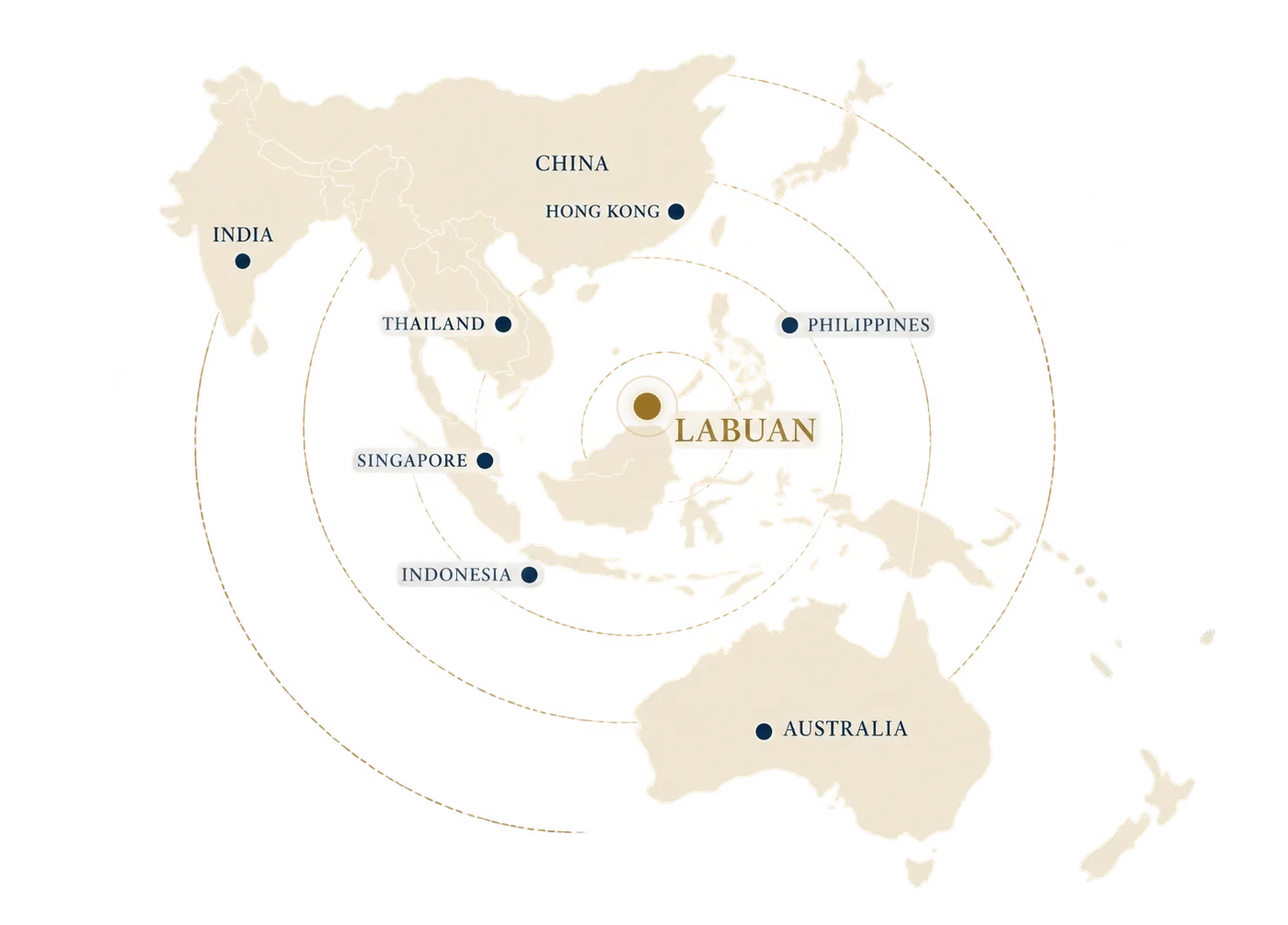
Labuan sits between the major business centres of Asia, from India and China to Singapore, Indonesia and Australia.
Labuan International Business and Financial Centre is an established and well-regulated jurisdiction in Asia, combining a competitive tax environment with a robust legal framework and political stability.
Labuan entities carrying on a Labuan trading activity that comply with the Economic Substance Requirements (ESR) pay 3% tax on net audited profits, a low rate for an internationally recognised, regulated jurisdiction.
ESR-compliant Labuan entities carrying on a Labuan non-trading activity are taxed at 0%.
Malaysia has concluded double tax agreements with over 70 countries. Access for a Labuan entity depends on the specific treaty, as some exclude Labuan structures.
Over three decades of development have made Labuan a mature, well-regulated jurisdiction with its own body of legislation and a dedicated financial services regulator: Labuan FSA.
Labuan operates in the same time zone as Singapore, Hong Kong, Beijing and Manila, making it operationally convenient for businesses across the Asia-Pacific region.
All licensing, compliance and regulatory matters are handled through one body, Labuan FSA, keeping the process straightforward and efficient for business owners.
Labuan is a small island off the north-west coast of Malaysian Borneo. Despite its size, it has built a substantial role as a financial centre, helped by its position within the Asia-Pacific region.
The island is easily accessible from Kuala Lumpur, Singapore, Hong Kong and the major business centres of South-East Asia. It shares its time zone with the region's most important financial markets, so a working day overlaps with clients in all of them.
For companies with interests in multiple Asian markets, Labuan provides a neutral, well-regarded base that is trusted by counterparties, banks and regulators across the region.
Labuan sits between the major business centres of Asia, from India and China to Singapore, Indonesia and Australia.
ESR-compliant Labuan trading companies pay a flat 3% on net audited profits. This applies to banking, insurance, leasing and certain qualified trading activities.
Entities used solely for investment holding pay 0% on their investment income, provided they meet substance requirements. This suits holding structures and family offices.
There is no capital gains tax and no withholding tax on dividends paid from a Labuan company, allowing efficient repatriation of profits for international shareholders.
Labuan operates under Malaysian law and enjoys the full support and commitment of the Malaysian government, providing a stable, predictable environment for long-term business structures.
Labuan has its own dedicated body of law, including the Labuan Business Activity Tax Act and Labuan Companies Act, providing legal clarity and separation from onshore Malaysian regulations.
Labuan is home to international and local banks offering multi-currency accounts, trade finance and treasury services. ITMC handles the banking and transaction support for the entities it manages.
Compared to Singapore or Hong Kong, the cost of setting up and maintaining a Labuan entity is generally lower.
Labuan law includes confidentiality provisions protecting client information, within an OECD-aligned reporting framework. This suits HNWI and family office structures.
Built on a common law foundation and aligned with international standards including FATF and OECD guidelines, Labuan maintains a clean, reputable image in the global financial community.
As Malaysian entities, qualifying Labuan companies can access elements of Malaysia's double tax agreement network, subject to the terms of each individual treaty.
A company incorporated elsewhere can be transferred into Labuan, and a Labuan company can move out, under the Labuan Companies Act. This gives long-term structures flexibility as circumstances change.
For current legislation, licensing requirements and regulatory updates, go to Labuan FSA, the sole regulator of the Labuan IBFC. Labuan IBFC Inc is the body that promotes and develops the jurisdiction.
The official website of the Labuan Financial Services Authority. Licensing, news, publications and regulatory updates.
labuanfsa.gov.my ↗The official website of Labuan IBFC Inc, the body that promotes and develops Labuan as a financial centre.
labuanibfc.com ↗Labuan IBFC is Malaysia's International Business and Financial Centre, established in 1990 on the island of Labuan off the coast of Borneo. It operates as a midshore jurisdiction regulated by the Labuan Financial Services Authority (Labuan FSA).
Labuan entities pay 3% tax on net audited profits from trading activities, or 0% on non-trading activities such as investment holding, subject to complying with the relevant substance requirements. Entities that do not comply are taxed at 24%.
Labuan entities must meet economic substance tests to access the preferential rates: a minimum number of full-time employees in Labuan and minimum annual operating expenditure, depending on the type of business activity carried on. These minimums are fixed in the regulations for each activity and do not change with turnover, so there is no second-guessing the numbers. The Inland Revenue Board of Malaysia (IRB) also checks that the employees are fit and proper. Entities that fail are taxed at the rate of 24%.
Malaysia has concluded over 70 double tax agreements. Whether a treaty applies to a Labuan entity depends on the specific treaty, as some exclude Labuan structures. Source: Inland Revenue Board Malaysia.
Labuan is more accurately described as a midshore jurisdiction. It applies a low tax regime with transparent reporting, adheres to OECD standards, and requires economic substance. This differs from classical no-tax, no-reporting havens.
The Labuan Financial Services Authority (Labuan FSA), established under the Labuan Financial Services Authority Act 1996, is the single statutory regulator responsible for licensing and supervising all financial institutions and intermediaries in Labuan IBFC.
Our team at ITMC has been guiding clients through Labuan structures since 1996. Speak to us. No obligation.